
Connecting Electricity and Magnetism – 1820

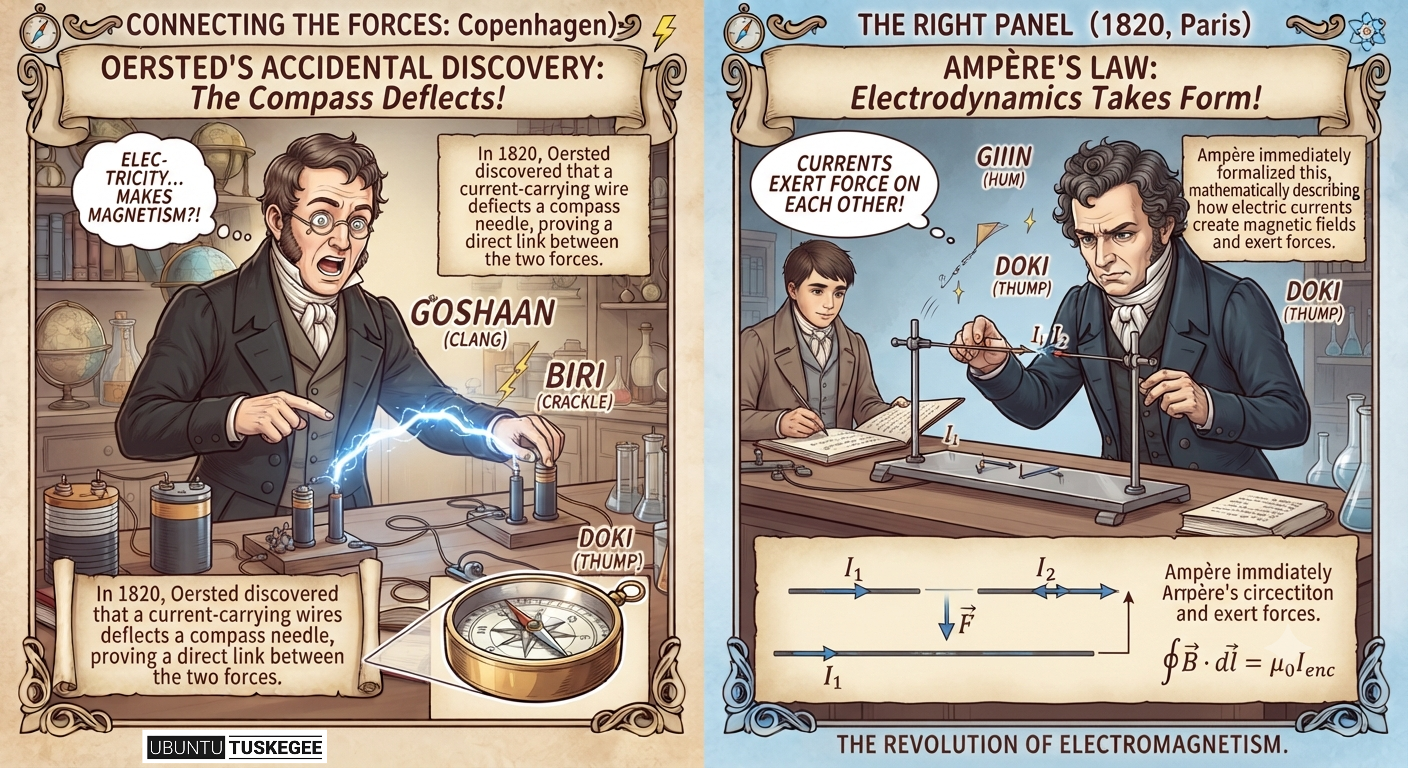
This panel captures the pivotal year of 1820, when the long-separated forces of electricity and magnetism were finally proven to be two sides of the same coin. The panel is split into two major breakthroughs!
Left: 1820, Copenhagen – Oersted’s Accidental Discovery
Hans Christian Oersted, a Danish physicist and professor, is shown in his laboratory during a lecture
demonstration. In the left panel, Oersted is caught in a moment of utter surprise as he touches a wire
connected to a voltaic pile (battery). Sparks fly and an electrical current surges through the wire. Right
next to it, a compass needle suddenly twitches and deflects away from pointing north.
The text box details his breakthrough: “In 1820, Oersted discovered that a current-carrying wire deflects
a compass needle, proving a direct link between the two forces.” Until this moment, scientists believed
electricity and magnetism were entirely separate forces of nature. Oersted noticed this relationship by
accident during a class, realizing that an electric current creates a magnetic field around it, which is
powerful enough to push a compass needle.
Right: 1820, Paris – Ampère’s Mathematical Formulation
André-Marie Ampère, a brilliant French physicist and mathematician, is depicted in his study following
the news from Copenhagen. Ampère is meticulously experimenting with parallel wires on a custom rig,
observing how currents running through them either attract or repel each other. His student assistant takes notes nearby. A thought bubble and text box highlight his rapid evolution of the concept: “Ampère immediately formalized this, mathematically describing how electric currents create magnetic fields and exert forces.” Upon hearing about Oersted’s discovery, Ampère went straight to work building a mathematical framework for it within just a few weeks.
The diagram and equation at the bottom
show Ampère’s Circuital Law, which mathematically links the magnetic field around a closed loop to the electric current passing through it, officially giving birth to the science of electrodynamics.
This panel illustrates how a sudden, accidental laboratory observation by Oersted in the spring of 1820 was instantly seized upon and transformed into precise mathematical law by Ampère later that same year, bridging two separate branches of physics forever!
Do you want to learn more?


