
Ancient Times: Electromagnetism

How did electricity and magnetism evolved from ancient observations into unified scientific theory?
Early Observations
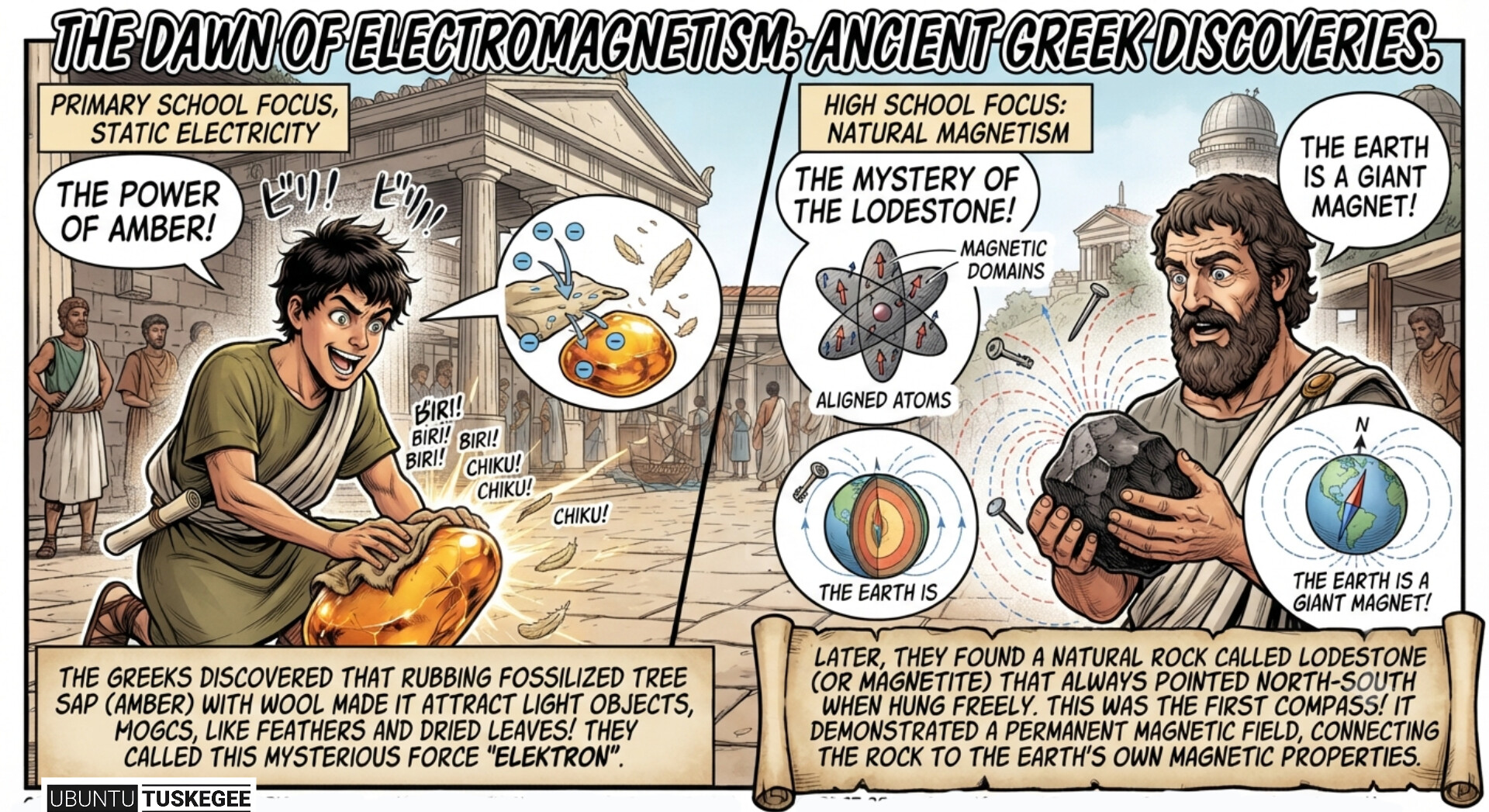
Ancient cultures like the Greeks observed static electricity by rubbing amber, and noticed the natural magnetic properties of lodestones/magnetite!
The Dawn of Electrostatics (left panel)
- Historical Context: The panel depicts Thales of Miletus (c. 600 BCE), one of the first documented observers of this phenomenon.
- Physics Explanation: This panel illustrates the triboelectric effect, where rubbing two different materials results in a charge transfer. Specifically, the wool transfers electrons to the amber, giving the amber a net negative charge. The charged amber then polarizes the neutral molecules in the lightweight feathers, creating an attractive force that overcomes gravity. The Greek term “elektron” (amber) is the etymological root for modern electrical terminology.
The Discovery of Natural Magnetism (right panel)
- Historical Context: This illustrates the discovery of magnetite (Fe₃O₄), commonly known as lodestone, in the region of Magnesia (modern-day Turkey).
- Physics Explanation: Lodestones are naturally occurring permanent magnets. The alignment of their internal magnetic domains (as seen in the atomic-level diagram) creates a macroscopic magnetic field, enabling them to exert force on ferromagnetic materials like iron. The diagram also correctly connects this property to the Earth’s own magnetic field, showing why a freely suspended lodestone functions as a compass.
DO YOU WANT TO LEARN AND EXPERIENCE SCIENCE WITH US?


