Skills First or Rights Now? Reflecting on the Atlanta Compromise

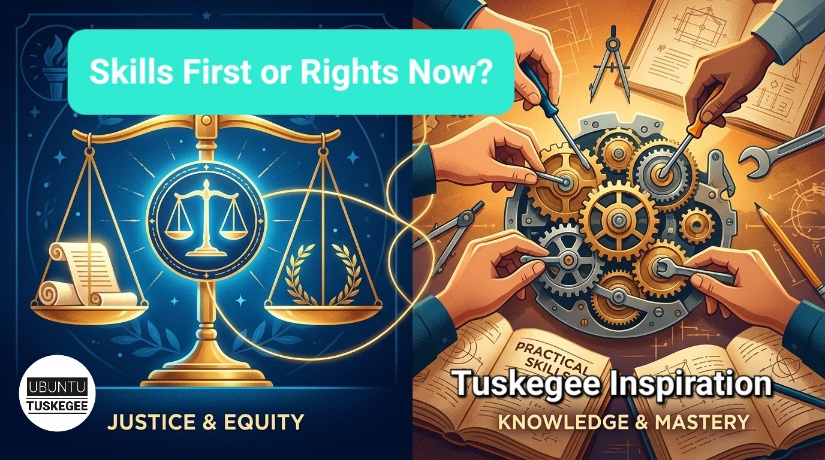
Is compromise a sound strategy in the fight for justice, or must full rights be demanded immediately?
Atlanta Compromise
Last week, our Tuskegee Inspiration discussion series brought us to a pivotal moment in history: Booker T. Washington’s 1895 “Atlanta Compromise” speech. Speaking on a national stage at the Cotton States and International Exposition, Washington delivered his famous metaphor: “In all things purely social we can be separate as the fingers, yet one as the hand in all things essential to mutual progress.”
Washington urged Black Americans to focus on economic progress, industrial education, and hard work, advocating patience when it came to political rights and social equality. His strategy made him a hero to many white leaders of the time, but a deeply controversial figure to Black contemporaries who felt immediate equality was non-negotiable.
Key Takeaways from Our Discussion
Our members weighed both sides of the debate, reflecting on how strategy, self-reliance, and justice intersect:
☆ The Power of Proving Capability: Focusing on skills and hard work demonstrates tangible value and capabilities, showing that a community cannot be easily ignored or dismissed.
☆ Building Internal Motivation: Hard work serves as a foundational motivator. Developing concrete skills builds self-confidence, agency, and practical momentum before entering broader social struggles.
☆ The Risk of Delaying Rights: On the flip side, compromising on basic rights risks sending the wrong message—creating a false narrative that human rights are something that must be earned through labor rather than granted inherently.
☆ The Long-Term Arc: Several participants noted that as skills and economic power improve, recognition and social leverage naturally follow over time.
Educator’s Perspective: Capacity as a Tool for Independence
Reflecting on the debate, our educator offered a pragmatic lens on Washington’s choices: Rights are fundamental, but rights without the immediate ability to provide for oneself leave a community vulnerable. Washington likely recognized the long, uphill battle against systemic resistance to political equality. By focusing heavily on capacity building, he sought to ensure that when rights were gained, the economic and practical foundation to thrive was already in place.
We see a similar pattern historically on the global stage: nations that develop strong economic capabilities gain significantly more negotiating power internationally. Building core capabilities fosters independence, giving individuals and communities the self-reliance needed to navigate—and ultimately reshape—unjust systems.
Where do you stand?
Does building economic power first lay the strongest foundation for lasting rights, or should equal rights always be the immediate starting point? Share your thoughts in the comments below, and join us for our next Tuskegee Inspiration session as we continue exploring history to power our future!
Enjoying the Free Study Aids?
Support the Ubuntu Tuskegee’s Education Initiative to help us build:
✔️ more FREE interactive study aids
✔️ low cost tuition support for students!
– Donate with Crypto 💛-
😄 FREE thanks to your support!
Your understanding and generosity advance our shared humanity!